The Complete Guide to Pickleball Paddle Shapes: Find the Best Fit for Your Game

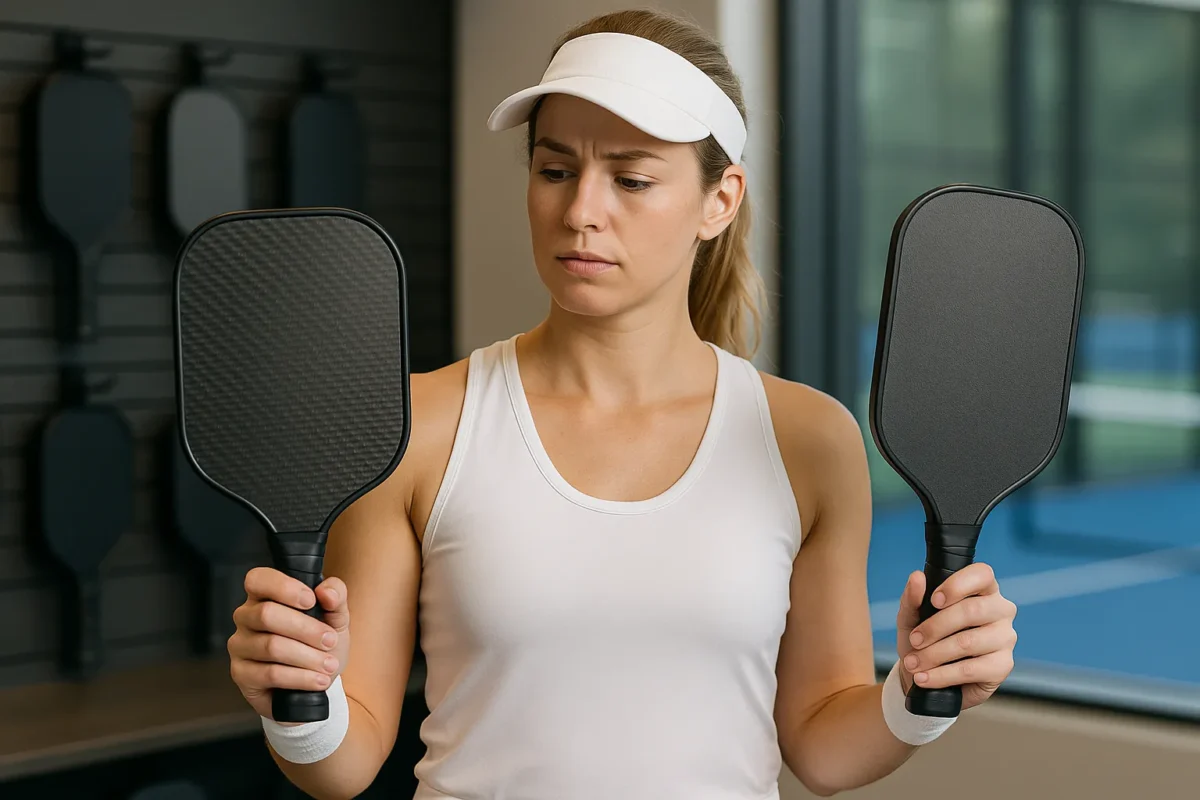
When it comes to improving your pickleball performance, paddle shape plays a critical role. While face materials and core types get a lot of attention, the shape of your paddle directly affects how you hit, move, and control the game.
In this guide, we break down the five most common paddle shapes: Widebody, Standard, Hybrid, Elongated, and Extra Elongated.
Why Paddle Shape Matters
Your paddle’s shape affects:
- Sweet spot size – how forgiving the paddle is on off-center hits
- Reach – how much court you can cover without overextending
- Power potential – how much force transfers into your shots
- Maneuverability – how quickly you can adjust during fast exchanges
Each shape comes with a general length range that helps define how it will feel and perform on the court.
Widebody Paddles
Widebody paddles are shorter and wider than other shapes, with most measuring less than 16 inches in total length.
Strengths:
- Large sweet spot helps reduce mishits
- Boosts consistency in dinks, resets, and blocks
- Improves control in tight net exchanges
Trade-Offs:
- Shorter reach limits ability to attack high or wide balls
- Less power leverage on drives and overheads
Best For: Players focused on touch, control, and forgiveness.
Standard Paddles
Standard paddles typically measure about 16 inches in length, offering a familiar, well-rounded profile.
Strengths:
- Balanced blend of power, control, and maneuverability
- Reliable option for players who value overall consistency
- Good for switching between offense and defense smoothly
Trade-Offs:
- Doesn’t specialize in any one area
- Moderate reach and sweet spot size
Best For: Players refining complete versatility in their game.
Hybrid Paddles
Hybrid paddles generally fall around 16.25 inches in length, striking a balance between reach and maneuverability.
Strengths:
- Adds slightly more reach than standard paddles
- Maintains a manageable weight and swing speed
- Helps with coverage without slowing hand speed
Trade-Offs:
- Smaller sweet spot than widebody paddles
- Doesn’t deliver the same power potential as full elongated shapes
Best For: Players wanting a balance between power and precision.
Elongated Paddles
Elongated paddles measure approximately 16.5 inches in length, offering an extended face for added leverage and reach. This shape is the most popular among current players.
Strengths:
- Increased reach for volleys, overheads, and angle coverage
- More leverage to generate power on drives and serves
- Higher vertical sweet spot, ideal for increasing leverage
Trade-Offs:
- Taller face leads to a higher vertical sweet spot
- Requires more precision and timing
Best For: Players focused on increasing power and reach.
Extra Elongated Paddles
Extra elongated paddles push paddle length beyond 16.5 inches, approaching the maximum dimensions allowed by official rules (typically 17″).
Strengths:
- Longest reach of any paddle shape
- Maximizes power, especially on serves and attacks
- Even higher vertical sweet spot, ideal for the most leverage possible
Trade-Offs:
- Reduced maneuverability in fast hand battles
- Demands precise control and technique
Best For: Players looking to maximize offensive reach and power.
Paddle Shape & Length Comparison
Here’s a quick side-by-side to help you visualize the performance traits and size of each shape:
| Shape | Typical Length | Strength Focus | Trade-Off |
|---|---|---|---|
| Widebody | Less than 16″ | Sweet spot size, control | Short reach, less power |
| Standard | Around 16″ | Balanced all-around performance | Doesn’t specialize |
| Hybrid | Around 16.25″ | Reach + maneuverability | Smaller sweet spot |
| Elongated | Around 16.5″ | Power, reach, vertical coverage | Less forgiving |
| Extra Elongated | Over 16.5″ | Max reach, leverage, power | Low maneuverability, precision required |
Conclusion: One Piece of the Paddle Puzzle
Choosing the right pickleball paddle shape is just one of many important decisions players face when finding the perfect paddle. While shape affects your reach, control, sweet spot size, and power, it works in combination with other key factors to determine how a paddle performs.
The best approach is to start with what you want to improve in your game, then select a shape that supports that goal. From there, you can explore paddle materials and construction to fine-tune your performance even further.
Remember, no single paddle shape fits everyone. But when matched with your playstyle and priorities, the right shape can give you a real edge on the court.